
A rare and threatened species in our midst! You can impact this turtle species’ future right here in Essex (and maybe Manchester too.) Help us identify where these turtles are by joining the MECT Turtle Watch.

1. Sign up for TurtleWatch alerts here.
Get alerts from MECT when turtles are on the move in our area, and learn what type of habitat they are most likely visiting as the seasons and weather change. These turtles are known to travel over a mile, covering an average of 40 acres during a single season, and they keep traveling at a turtle’s speed into their eightieth and ninetieth years! We’re in touch with a local wildlife biologist who is monitoring another Blanding’s site outside of Essex, but close enough that the turtle movements should be in sync. We expect them to be active in June, especially on rainy evenings. We are not certain if the cool spring will shift this activity.
This information is provided to help learn where they are in our community for their protection. Through education, signage and safe travel and nesting areas on conservation land, we hope to support the existing local turtle population. We will not share exact locations. Please respect these beauties and their desire to live freely outdoors. It is unlawful to possess Blanding’s Turtles in Massachusetts. Handling turtles requires a state permit. Please refrain from touching turtles, unless you are facilitating a road crossing.
2. Take a picture. Report turtle sightings.
These will help us document the extent of their territories. Send photos to us at conserve@mect.org with information about the date and location or give us a call at 978-890-7153.
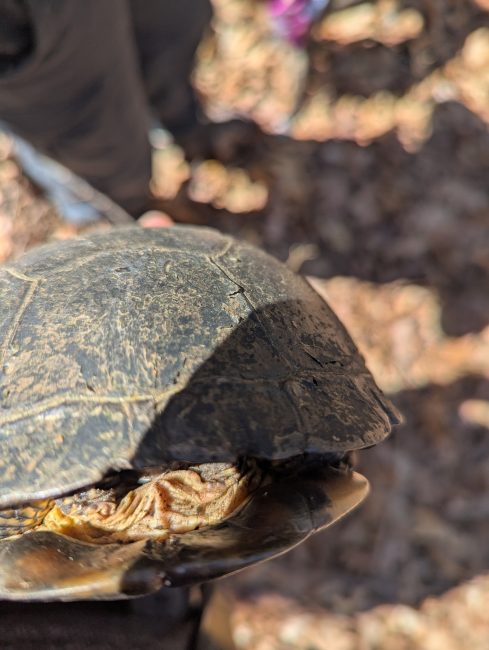
The eye-catching photo above is a true representation of a young Blanding’s turtle, but you may see much older, or mossy, mud-covered turtles that are hardly recognizable on land or on logs. On our training walks, I passed right by an ancient Blanding’s turtle, thinking she was a discarded landscape container half covered by leaf litter. See the photos below to see what they often look like in the field. Blanding’s turtles seen on logs will have a higher dome than the more common painted turtles. Both species of turtles extend their necks as they sunbathe. Blanding’s turtles basking on logs are very shy and will slip into the water quickly. We recommend scouting for them over ponds with a camera with a 300mm zoom or higher, or binoculars.
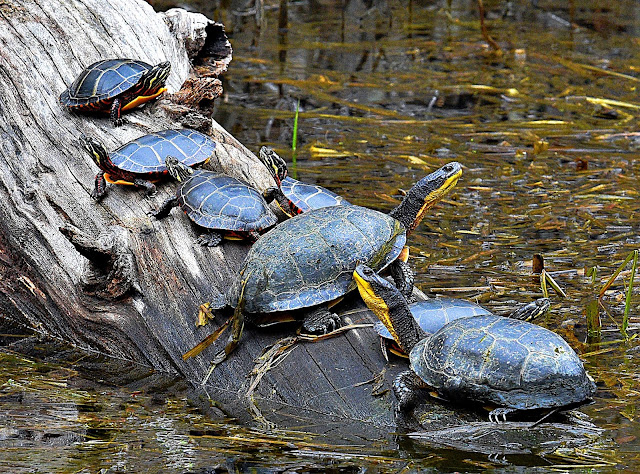
If we numbered the turtles on this log from the bottom (1) to top (7), turtles number 1 and 3 are Blanding’s Turtles. Note their larger size, their higher dome shape, and their yellow throats. The painted turtles have predominantly black throats, and yellow striping on their neck and head. Painted turtles also often have bright red marking on their shell, which the Blanding’s lack. Some Blanding’s will have yellow specks on their shells.



3. Learn why this is important NOW.
The MA Natural Heritage Endangered Species Program tracks and protects endangered species in our state. The last time someone reported a Blanding’s Turtle here was many years ago – though the program believes that they certainly live in our area today. The program is tight on resources, and has not dedicated them to turtles, salamanders and other endangered species in our area. They’ve remarked that this region is far away from their headquarters. So it’s up to us to document the local population and make sure the turtles live among us as safely as possible. We believe that protecting the small populations of Blanding’s Turtles that live in our preserved areas – and outside of our preserved areas is important – we just need to know where they are, so that we can help! These turtles are sensitive to loss of safe connectivity in their territory between their aquatic habitats, and their nesting habitats. Depending on where they are documented we can consider a number of mitigation efforts like creating suitable nesting habitat on conservation land and road-free paths to get there.
4. Share some Turtle Facts with friends and neighbors.
- Scientific name: Emydoidea blandingii
- Most distinctive feature: Yellow throat/neck and yellow lower jaw
- Size: Adults typically reach 7-10 inches
- Conservation Status
- Threatened (MA Endangered Species Act)
- Under review for federal Threatened status under the Endangered Species Act (2025)
- Species of Greatest Conservation Need (MA State Wildlife Action Plan)
- Omnivorous (snails, crayfish, earthworms, insects, small fish, carrion, duckweed, bulrushes, and sedges and more)
- Female Blanding’s turtles reach sexual maturity around 14–18 years old, resulting in slow population growth and recovery from declines
- Massachusetts is home to ten native species of terrestrial and aquatic turtles. Six of the 10 species are protected under the Massachusetts Endangered Species Act, including the Blanding’s turtle.
5. Dig in to learn more.
Blanding’s Turtle (Emydoidea blandingii) | U.S. Fish & Wildlife Service